[progressbar heading=”Rp. 20.970.000″ wip_title=”terkumpul dari target Rp 35.000.000 ” unit_of_measure=”%” your_goal=”100″ current_score=”60″ progress_bar_color=”green” progress_bar_border=”black” candy_stripe_options=”animated” progress_bar_height=”20″ progress_bar_media=”” font_color=”” more_information=”⏲ Sisa 5 hari lagi” include_hyperlink=”” hyperlink_text=”http://sulsel.dompetdhuafa.org/donasi/bantu-perbaikan-rumah-nenek-timang/” hyperlink=”http://sulsel.dompetdhuafa.org/bantu-nenek-timang-punya-rumah-layak/” include_own_progress_bar=””] Continue reading →
Profil Dompet Dhuafa Sulsel
Segala tentang Dompet Dhuafa Sulsel
Respon Gempa Pidie Aceh, DMC DD Kirim Tim Respon
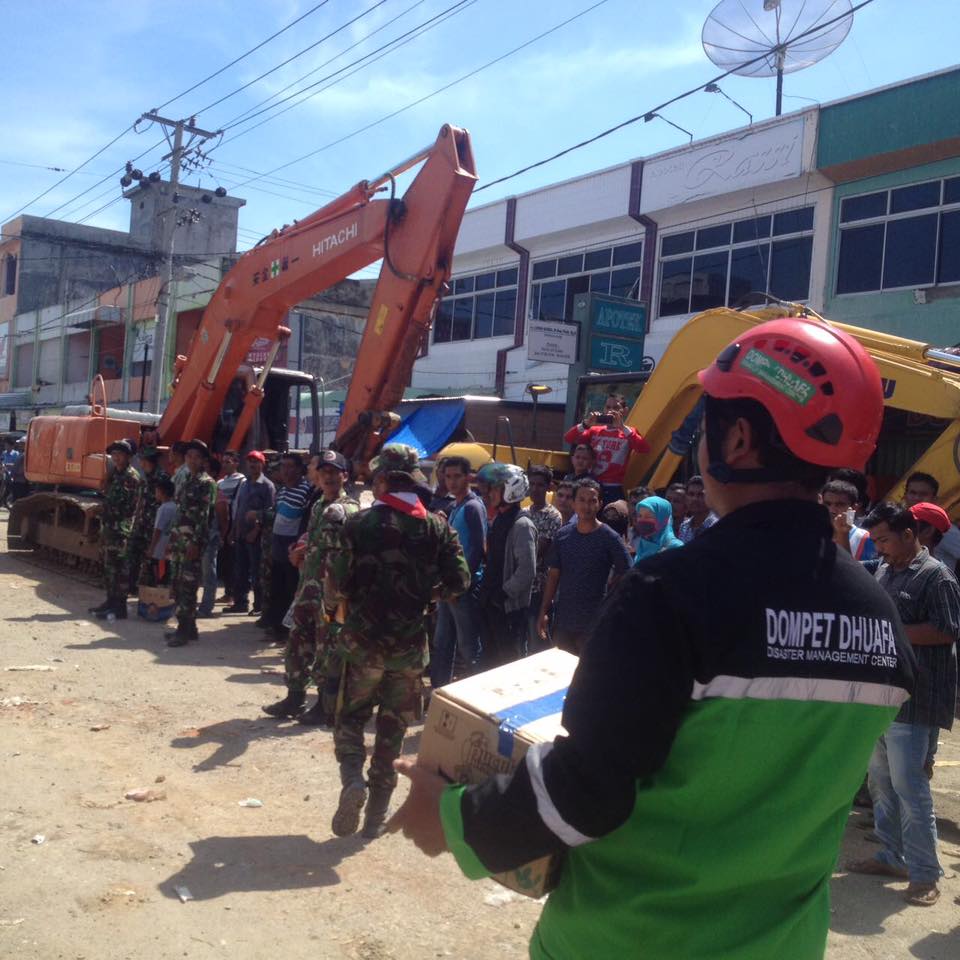
JAKARTA (KBK) – Tidak lama setelah Gempa Pidie Jaya, Aceh terjadi dan dikabarkan menimbulkan banyak korban dan gedung yang hancur, Direktur Disaster Management Center (DMC) Dompet Dhuafa Syamsul Ardiansyah segara melangsungkan rapat darurat bersama tim respon di Rempoa.
Ia pun segera mengkoordinasikan dengan Relawan Dompet Dhuafa Waspada Medan (Dompet Dhuafa Volounteer (DDV)). Alhasil, hari ini Rabu (7/12/2016), DMC segera menurunkan tim respon, dua orang dikirim dari Rempoa Jakarta dan tim DD Waspada Medan melalui darat menuju Pidie Jaya Aceh.
Instruksi yang akan dijalankan Tim Respon, ungkap Syamsul, melaksanakan tugas utama melakukan asesmen kebutuhan, dengan fokus asesmen pada dua layanan dasar, yakni pendidikan dan kesehatan korban gempa.
“Asumsi kami, kedua layanan dasar tersebut turut terdampak oleh gempa pagi ini. Pulihnya kedua layanan ini sangat krusial untuk membantu pengurangan penderitaan masyarakat,” ungkap Syamsul kepada KBK.
Untuk layanan pendidikan, kata Syamsul, Tim DMC akan disupport oleh DDV Medan. Sementara untuk layanan kesehatan, DMC akan mengoptimalkan support dari LKC Aceh.
Gempa 6,4 SR Guncang Aceh, 18 Orang Meninggal
ACEH – Gempa berkekuatan 6,4 skala Richter yang mengguncang Kabupaten Pidie Jaya, Aceh, Rabu (7/12/2016), telah menelan korban tewas sedikitnya 18 orang.
Wakil Bupati Pidie Said Mulyadi menjelaskan, sampai saat ini tercatat korban meninggal sebanyak 18 orang. Pendataan terus dilakukan baik yang sudah meninggal dunia dan juga terluka akibat reruntuhan bangunan.
“Ini terus kita data, sementara ada 18 korban meninggal dunia, banyak yang luka parah dibawa ke rumah sakit,” terang Said, dikutip Okezone dari iNews TV, Rabu (07/12/2016).
Kabupaten Pidie Jaya, Aceh, diguncang gempa tektonik pukul 05.03 WIB dengan kekuatan 6,4 SR. Akibat gempa itu, sejumlah bangunan dilaporkan mengalami kerusakan. Warga yang panik akan gempa pun berhamburan keluar rumah.
Data yang dirilis Badan Meteorologi Klimatologi dan Geofisika (BMKG), lokasi gempa terjadi pada 5.19 Lintang Utara, 96.36 Bujur Timur, 18 kilometer timur laut Kabupaten Pidie Jaya, Aceh.
Students take crash course in Japanese sword fighting
[vc_row][vc_column][vc_column_text css=”.vc_custom_1473172590468{margin-bottom: 27px !important;}”]A new study led by Professor of Physical Medicine & Rehabilitation Jane Eckhart found that a group of runners who had never been hurt landed each footfall more softly than a group who had been injured badly enough to seek medical attention.[/vc_column_text][vc_column_text css=”.vc_custom_1473172543824{margin-bottom: 30px !important;}”]As evidence has mounted that distance running is not just a natural human activity enjoyed by millions, but one that played a key role in evolution, a puzzle has emerged. Why, if humans are so well adapted to running long distances, do runners get hurt so often?[/vc_column_text][vc_column_text css=”.vc_custom_1473172634050{margin-bottom: 40px !important;}”]A study out of Smart School and the National Running Center at Smart-affiliated Templeton Rehabilitation Hospital provides a puzzle piece, linking injury to the pounding runners’ bones take with each step. The work, led by Professor of Physical Medicine and Rehabilitation Jane Eckhart, found that a group of runners who had never been hurt landed each footfall more softly than a group who had been injured badly enough to seek medical attention.[/vc_column_text][vc_row_inner css=”.vc_custom_1473173012608{margin-bottom: 14px !important;}”][vc_column_inner width=”2/12″][/vc_column_inner][vc_column_inner width=”8/12″][stm_mg_audio][/vc_column_inner][vc_column_inner width=”2/12″][/vc_column_inner][/vc_row_inner][vc_column_text css=”.vc_custom_1473172693280{margin-bottom: 40px !important;}”]Statistics on such injuries vary, but somewhere between 30 percent and 75 percent of runners are hurt annually, a number that has led researchers to investigate a wide array of possible explanations, from modern running shoes to stretching, running frequency, weight, biomechanical misalignment, and muscle imbalance.[/vc_column_text][vc_row_inner][vc_column_inner width=”5/12″][stm_blockquote cite=”Francesca Stoppard The Darvin B. Xander Associate Curator of Prints”]One never injured multi-marathoner’s stride was so smooth, she ran like an insect over water. Weight was not a factor, with heavy runners among the light-footed and lighter runners among the stompers.[/stm_blockquote][/vc_column_inner][vc_column_inner width=”7/12″][vc_column_text css=”.vc_custom_1473172969666{margin-top: -10px !important;margin-bottom: 30px !important;}”]With most runners being heel-strikers today, the added shock, multiplied over thousands of footsteps, could explain high injury rates. The 2012 study added fuel to the debate, finding a two-to-one difference in repetitive stress injuries between heel- and forefoot-strikers.[/vc_column_text][vc_column_text css=”.vc_custom_1473172807857{margin-bottom: 40px !important;}”]Jane Eckhart’s research focused on heel-strikers exclusively, since they make up most of today’s runners, and examined a cohort seldom studied, partly because they’re pretty rare: those who have never been injured. Jane and colleagues recruited 249 female recreational athletes who each ran at least 20 miles a week. They investigated the participants’ strides by having them run over a force plate that recorded the impact of each step.[/vc_column_text][/vc_column_inner][/vc_row_inner][vc_column_text css=”.vc_custom_1473173112409{margin-bottom: 0px !important;}”]The runners agreed to respond to a monthly online questionnaire that detailed injuries over two years. With the results in, researchers first examined reports from the 144 who experienced a mild injury and the 105 who didn’t, finding little difference between the two large groups.[/vc_column_text][/vc_column][/vc_row]
Faculty of Social Sciences and Humanities celebrates students success
[vc_row][vc_column][vc_column_text css=”.vc_custom_1473172590468{margin-bottom: 27px !important;}”]A new study led by Professor of Physical Medicine & Rehabilitation Jane Eckhart found that a group of runners who had never been hurt landed each footfall more softly than a group who had been injured badly enough to seek medical attention.[/vc_column_text][vc_column_text css=”.vc_custom_1473840168330{margin-bottom: 30px !important;}”]As evidence has mounted that distance running is not just a natural human activity enjoyed by millions, but one that played a key role in evolution, a puzzle has emerged. Why, if humans are so well adapted to running long distances, do runners get hurt so often?[/vc_column_text][vc_column_text css=”.vc_custom_1473840176714{margin-bottom: 40px !important;}”]A study out of Smart School and the National Running Center at Smart-affiliated Templeton Rehabilitation Hospital provides a puzzle piece, linking injury to the pounding runners’ bones take with each step. The work, led by Professor of Physical Medicine and Rehabilitation Jane Eckhart, found that a group of runners who had never been hurt landed each footfall more softly than a group who had been injured badly enough to seek medical attention.[/vc_column_text][vc_row_inner css=”.vc_custom_1473173012608{margin-bottom: 14px !important;}”][vc_column_inner width=”2/12″][/vc_column_inner][vc_column_inner width=”8/12″][stm_mg_audio][/vc_column_inner][vc_column_inner width=”2/12″][/vc_column_inner][/vc_row_inner][vc_column_text css=”.vc_custom_1473840225554{margin-bottom: 40px !important;}”]Statistics on such injuries vary, but somewhere between 30 percent and 75 percent of runners are hurt annually, a number that has led researchers to investigate a wide array of possible explanations, from modern running shoes to stretching, running frequency, weight, biomechanical misalignment, and muscle imbalance.[/vc_column_text][vc_row_inner][vc_column_inner width=”1/2″][stm_blockquote cite=”Jane Eckhart Professor of Physical Medicine & Rehabilitation”]One never injured multi-
marathoner’s stride was so smooth, she ran like an insect over water. Weight was not a factor, with heavy runners among the light-footed and lighter runners among the stompers.[/stm_blockquote][/vc_column_inner][vc_column_inner width=”1/2″][vc_column_text css=”.vc_custom_1473845716506{margin-top: -10px !important;margin-bottom: 30px !important;}”]Please meet in the Calderwood Courtyard, in front of the digital screens between the shop and the admissions desk. Museums staff will be on hand to collect tickets.[/vc_column_text][vc_column_text css=”.vc_custom_1473845757345{margin-bottom: 40px !important;}”]Jane Eckhart’s research focused on heel-strikers exclusively, since they make up most of today’s runners, and examined a cohort seldom studied, partly because they’re pretty rare: those who have never been injured. They investigated the participants’ strides by having them run over a force plate that recorded the impact of each step.[/vc_column_text][/vc_column_inner][/vc_row_inner][vc_column_text css=”.vc_custom_1473840252221{margin-bottom: 0px !important;}”]The runners agreed to respond to a monthly online questionnaire that detailed injuries over two years. With the results in, researchers first examined reports from the 144 who experienced a mild injury and the 105 who didn’t, finding little difference between the two large groups.[/vc_column_text][/vc_column][/vc_row]
Actor Jeff Soberg will be Smart’s 2016 speaker
[vc_row][vc_column][vc_column_text css=”.vc_custom_1473172590468{margin-bottom: 27px !important;}”]A new study led by Professor of Physical Medicine & Rehabilitation Jane Eckhart found that a group of runners who had never been hurt landed each footfall more softly than a group who had been injured badly enough to seek medical attention.[/vc_column_text][vc_column_text css=”.vc_custom_1473172543824{margin-bottom: 30px !important;}”]As evidence has mounted that distance running is not just a natural human activity enjoyed by millions, but one that played a key role in evolution, a puzzle has emerged. Why, if humans are so well adapted to running long distances, do runners get hurt so often?[/vc_column_text][vc_column_text css=”.vc_custom_1473172634050{margin-bottom: 40px !important;}”]A study out of Smart School and the National Running Center at Smart-affiliated Templeton Rehabilitation Hospital provides a puzzle piece, linking injury to the pounding runners’ bones take with each step. The work, led by Professor of Physical Medicine and Rehabilitation Jane Eckhart, found that a group of runners who had never been hurt landed each footfall more softly than a group who had been injured badly enough to seek medical attention.[/vc_column_text][vc_row_inner css=”.vc_custom_1473173012608{margin-bottom: 14px !important;}”][vc_column_inner width=”2/12″][/vc_column_inner][vc_column_inner width=”8/12″][stm_mg_audio][/vc_column_inner][vc_column_inner width=”2/12″][/vc_column_inner][/vc_row_inner][vc_column_text css=”.vc_custom_1473172693280{margin-bottom: 40px !important;}”]Statistics on such injuries vary, but somewhere between 30 percent and 75 percent of runners are hurt annually, a number that has led researchers to investigate a wide array of possible explanations, from modern running shoes to stretching, running frequency, weight, biomechanical misalignment, and muscle imbalance.[/vc_column_text][vc_row_inner][vc_column_inner width=”5/12″][stm_blockquote cite=”Francesca Stoppard The Darvin B. Xander Associate Curator of Prints”]One never injured multi-marathoner’s stride was so smooth, she ran like an insect over water. Weight was not a factor, with heavy runners among the light-footed and lighter runners among the stompers.[/stm_blockquote][/vc_column_inner][vc_column_inner width=”7/12″][vc_column_text css=”.vc_custom_1473172969666{margin-top: -10px !important;margin-bottom: 30px !important;}”]With most runners being heel-strikers today, the added shock, multiplied over thousands of footsteps, could explain high injury rates. The 2012 study added fuel to the debate, finding a two-to-one difference in repetitive stress injuries between heel- and forefoot-strikers.[/vc_column_text][vc_column_text css=”.vc_custom_1473172807857{margin-bottom: 40px !important;}”]Jane Eckhart’s research focused on heel-strikers exclusively, since they make up most of today’s runners, and examined a cohort seldom studied, partly because they’re pretty rare: those who have never been injured. Jane and colleagues recruited 249 female recreational athletes who each ran at least 20 miles a week. They investigated the participants’ strides by having them run over a force plate that recorded the impact of each step.[/vc_column_text][/vc_column_inner][/vc_row_inner][vc_column_text css=”.vc_custom_1473173112409{margin-bottom: 0px !important;}”]The runners agreed to respond to a monthly online questionnaire that detailed injuries over two years. With the results in, researchers first examined reports from the 144 who experienced a mild injury and the 105 who didn’t, finding little difference between the two large groups.[/vc_column_text][/vc_column][/vc_row]